Episode 01
Kingship from Heaven
A four-thousand-year-old clay prism claims kingship descended from heaven, eight rulers governed for 241,200 years, and a flood divided time itself. Mariana Eaker and Tyson Lukowski investigate where the Sumerian King List moves from political history into myth, and why later traditions remembered fish-cloaked sages who delivered civilization.
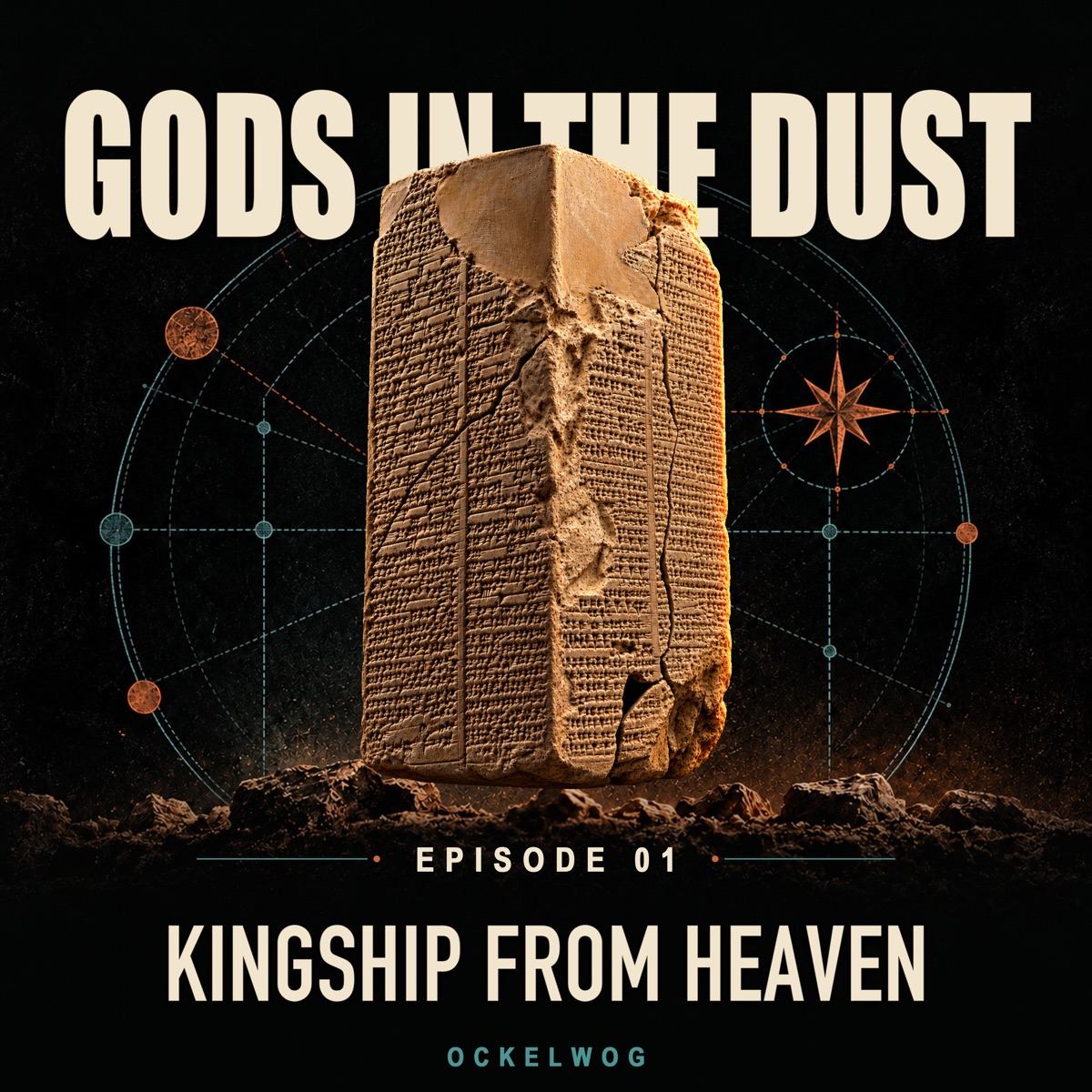
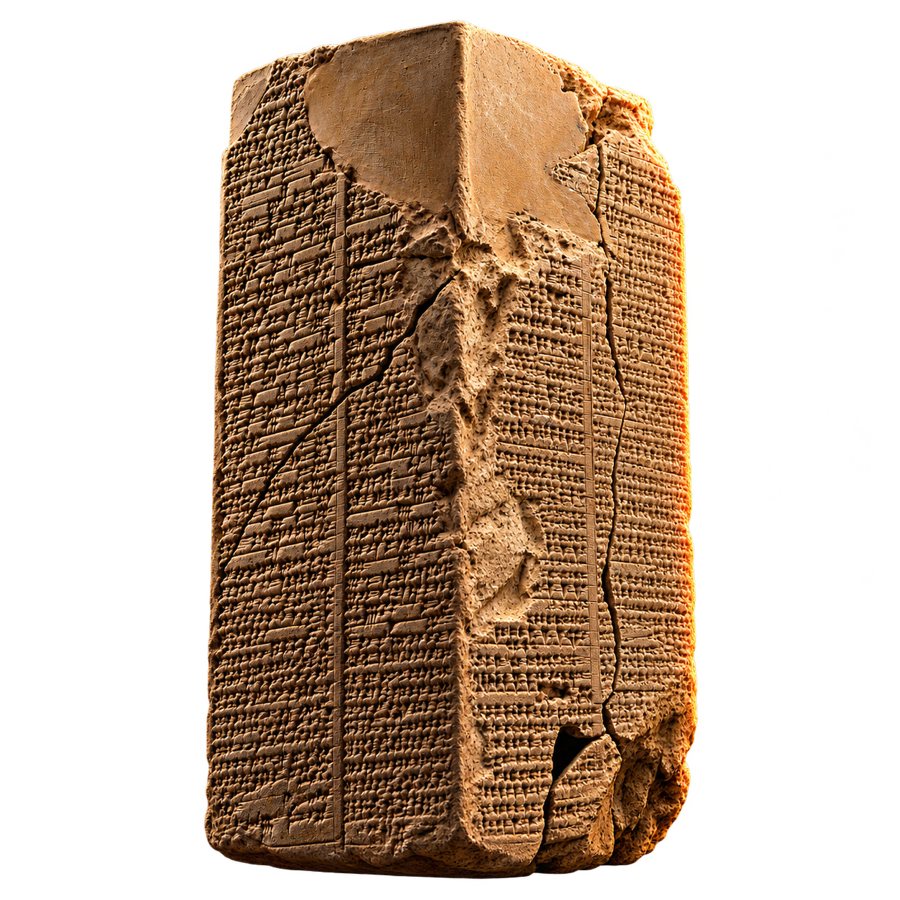
3D model: “The Sumerian King List” by Ingmar Franz, CC BY 4.0.
The evidence
Weld-Blundell Prism
The most complete surviving copy of the Sumerian King List. Four faces of cuneiform run from kings with impossible reigns, across a flood, to rulers who left evidence in the ground.
- Date
- c. 1800 BCE
- Place
- Larsa, Iraq
- Held
- Ashmolean Museum, Oxford
- Catalog
- AN1923.444
Show notes
The Weld-Blundell Prism does something modern history is not supposed to do. It begins with impossible kings and divine authority, crosses a flood in a single sentence, then continues toward rulers who may have left evidence in the ground. Mariana and Tyson follow that transition through Mesopotamian number symbolism, the historical shadow of Enmebaragesi, flood deposits at ancient cities, Eridu’s sacred geography, the apkallu sages, and Berossus’s account of Oannes. Then they give the ancient-visitor interpretation a direct evidence test. The result is stranger than a simple debunking. The tablets do describe civilization as received knowledge, but they also reveal a recognizably human conspiracy: rulers using inherited memory, sacred language, and catastrophe to make political power appear older than argument. Full textual, museum, and archaeological sources are linked below.
Sources
TranscriptRead along. Section times jump the player.
Cold open
Mariana There's a clay prism in Oxford that begins with a sentence historians have spent more than a century trying to domesticate.
Tyson "After kingship descended from heaven."
Mariana Not a king. Kingship itself. It comes down, takes up residence in a city, and stays there while eight rulers govern for a combined two hundred and forty-one thousand, two hundred years.
Tyson And then the flood arrives.
Mariana Four words. A clean break in the record. The world before it's gone. Kingship descends again, and the list continues toward people archaeologists think may actually have lived.
Tyson That's the problem. If this were only mythology, we could put it in the mythology drawer. If it were only a king list, we could argue about dates. But it changes category while you're reading it.
Mariana So what exactly are we holding? A history contaminated by legend? A political forgery? A memory of catastrophe? Or the remains of a claim that civilization didn't begin here at all?
Mariana I’m Mariana Eaker.
Tyson I’m Tyson Lukowski.
Mariana And this is Gods in the Dust.
Theme music
The object in the case
Mariana The object is called the Weld-Blundell Prism. If you visit the Ashmolean Museum in Oxford, you're looking for a block of clay about eight inches tall, wider at the middle, with four faces covered in compact wedges. Each face has two columns. Eight columns in all.
Tyson It doesn't look futuristic. It doesn't glow. No one pulled it from a machine under a pyramid. It looks exactly like what you'd expect, a document made by a trained scribe using wet clay and a reed stylus.
Mariana Probably around eighteen hundred BCE. That date matters because the earliest kings named in the text are supposed to have ruled hundreds of thousands of years before the scribe was born.
Tyson Which means the prism isn't a contemporary record of those first kings.
Mariana Not remotely. It's a copy of a tradition. And it's not the only copy. Versions of the Sumerian King List survive from different places. They overlap, but they don't perfectly agree.
Tyson Names change. Reign lengths change. A dynasty can appear in one manuscript and disappear in another. One version may promote a city another version barely acknowledges.
Mariana That doesn't make the text useless. It tells us what kind of object it is. This isn't a spreadsheet accidentally damaged by time. It's a political story under continuous revision.
Tyson The Ashmolean calls it "ancient political spin," which is refreshingly direct for a museum label.
Mariana The list imagines kingship as one transferable substance. It belongs to a city for a while. Then the city falls and kingship moves somewhere else. Eridu. Bad-tibira. Larak. Sippar. Shuruppak. After the flood, Kish. Later, Uruk, Ur, Awan, Hamazi, and other centers enter the sequence.
Tyson Real Mesopotamia wasn't that orderly. Cities competed. Dynasties overlapped. One ruler could claim supremacy while another ruler made the same claim two hundred miles away.
Mariana But the list flattens those rival powers into a single file. One city after another. One legitimate center at a time.
Tyson And the Oxford copy ends with the rulers of Isin.
Mariana Conveniently.
Tyson Extremely conveniently.
Mariana If you rule Isin, this document says your authority isn't a local accident. It's the current resting place of something the gods lowered into the world at the beginning of civilization.
Tyson So our first explanation is propaganda.
Mariana Political theology. Propaganda sounds like the information is simply false. This is more durable. It takes the mess of conquest, inheritance, and collapse and gives it a cosmic shape.
Tyson But propaganda can preserve older memories. A government can use a story without inventing every part of it.
Mariana Yes. That's why the beginning of the list matters. Its political purpose explains why it was copied. It doesn't fully explain where its strangest material came from.
Eight kings and too much time
Tyson Let’s read the first section the way the scribe presents it. Kingship comes down from heaven and settles in Eridu. Alulim becomes king.
Mariana He rules for twenty-eight thousand, eight hundred years.
Tyson Then Alaljar rules for thirty-six thousand. Eridu falls. Kingship moves to Bad-tibira, where three kings divide another hundred and eight thousand years.
Mariana It moves again. Larak gets one king and twenty-eight thousand, eight hundred years. Sippar gets one king and twenty-one thousand years. Then Shuruppak receives Ubara-Tutu for eighteen thousand, six hundred.
Tyson Eight kings. Five cities. Two hundred and forty-one thousand, two hundred years.
Mariana That total is in the text. The scribe isn't embarrassed by it.
Tyson The first rescue attempt is always conversion. Maybe a "year" means a month. Maybe we're applying the wrong unit.
Mariana Convert the longest reign into lunar months and you still get thousands of solar years. Change the unit again and you're inventing a key the document doesn't supply.
Tyson Another theory says the names represent dynasties rather than individuals.
Mariana Possible as a modern interpretation, but the grammar treats them as rulers. The document counts kings, not houses.
Tyson So the numbers aren't failed chronology. They're successful symbolism.
Mariana That's the stronger reading. Mesopotamian mathematics used a base-sixty system. Their scribes worked comfortably with large, patterned totals. Several antediluvian reigns are elegant multiples inside that numerical world.
Tyson Thirty-six thousand. Twenty-eight thousand, eight hundred. Forty-three thousand, two hundred. These don't feel like somebody estimating how long ago a grandfather lived.
Mariana They feel composed.
Tyson Which raises an interesting possibility. The size is the point. Before the flood, time operates at a different scale. Those kings don't merely live longer. They belong to a world structurally unlike ours.
Mariana Then the flood cuts that scale down. Afterward, the reigns remain impossible, but they contract. Twelve hundred years. Nine hundred. Six hundred. Eventually decades.
Tyson Mythic time cooling into human time.
Mariana Or a compiler joining incompatible kinds of source material and using the flood as the seam.
Tyson You always choose the answer with fewer glowing doors.
Mariana I choose the answer that requires fewer invisible machines.
Tyson Fair. But the seam is still there. If the list were pure myth, we'd expect the people near the beginning to remain mythic. If it were ordinary history, we'd expect the numbers to behave. Instead, the document walks from one mode into the other without telling us where the floor changes.
The man at the edge of history
Mariana Near that changing floor is a ruler named Enmebaragesi of Kish.
Tyson The King List gives him nine hundred years.
Mariana Which he didn't live.
Tyson But unlike Alulim, Enmebaragesi isn't confined to later literary tradition. His name appears in early inscriptions. Fragments bearing the name of a king of Kish have been recovered from the archaeological record.
Mariana That doesn't validate the nine hundred years. It tells us the list eventually incorporated rulers with an independent historical footprint.
Tyson He also enters the world around Gilgamesh. Mesopotamian tradition makes Enmebaragesi the father of Aga, the king of Kish who confronts Gilgamesh of Uruk.
Mariana And Gilgamesh is the perfect example of the problem. A later epic turns him into the hero who meets monsters, rejects a goddess, loses his closest friend, and searches for the survivor of the flood. But many scholars think a ruler behind the stories may have existed.
Tyson A real king becomes a literary giant. Then later readers try to reverse the process and recover the man.
Mariana The King List does the opposite. It takes rulers remembered in different ways and threads them into one succession. Some may be historical. Some legendary. Some may be names preserved because scribes needed the chain to reach the present.
Tyson Once one ruler steps out of the mist and leaves an inscription, every impossible name behind him becomes more seductive.
Mariana Seductive is the word. Not confirmed.
Tyson But this is where people begin asking whether the early section is distorted memory. Not fiction. Memory enlarged by centuries of retelling.
Mariana That's possible in a general sense. Oral and written traditions can preserve names, places, disasters, and political relationships while radically changing scale and detail.
Tyson So could Alulim preserve a ruler from a period before writing?
Mariana Could he? Yes. Do we've evidence that he does? No. There's a difference between a possibility the evidence permits and a conclusion the evidence supports.
Tyson That distinction may be the entire show.
Mariana It may be.
The line of water
Mariana After the five first cities and eight first kings, the text gives us one line.
Tyson "Then the flood swept over."
Mariana No warning. No boat. No survivor. Just a border.
Tyson Another Sumerian tablet supplies the missing story. It survives only in part. The beginning is damaged, but what remains describes the founding of cities and a divine decision to destroy humankind.
Mariana Enki warns a ruler named Ziusudra. The warning is indirect, spoken through a wall. Ziusudra builds a vessel. Wind and storm overwhelm the land for seven days and seven nights.
Tyson Then the sun returns. Ziusudra opens the vessel, sacrifices, and bows. An and Enlil grant him life in a distant place.
Mariana That tablet was copied around the seventeenth century BCE. Later Mesopotamian traditions tell related stories through Atrahasis and Utnapishtim. The Standard Babylonian Epic of Gilgamesh gives Utnapishtim a long account of the deluge. Much later, the Hebrew tradition gives us Noah.
Tyson The structure repeats. A divine decision. A warning. A vessel. Preservation of life. A storm. A sacrifice when the water recedes.
Mariana The differences matter too. Different gods. Different motives. Different dimensions. Different moral worlds.
Tyson And southern Mesopotamia doesn't need an imaginary ocean to produce catastrophic water. The cities stood on a broad alluvial plain shaped by the Tigris and Euphrates, irrigation channels, changing river courses, and seasonal floods.
Mariana Archaeologists have found flood deposits at multiple sites, including layers at places such as Shuruppak, Kish, and Ur.
Tyson This is usually where a television narrator says, "proof of the flood."
Mariana It's proof of floods. The layers occur at different sites, at different depths, and apparently at different times. They don't establish one simultaneous flood covering the entire planet, or even all of Mesopotamia.
Tyson At Ur, Leonard Woolley found a deep clean deposit and initially connected it to the biblical flood. The discovery was dramatic. The interpretation traveled farther than the evidence.
Mariana Woolley’s workers had dug through graves and occupation layers when they reached a thick band of clean silt. Below it, human occupation continued. For a moment the trench seemed to show the world before and after a deluge.
Tyson That's almost too perfect.
Mariana Which should make us careful. A dramatic trench is still one trench. Elsewhere at Ur, the deposit didn't appear in the same way. The flood had been devastating, but local.
Tyson At Shuruppak, the city the tradition places immediately before the deluge, excavators also identified a flood deposit.
Mariana Yes, and that coincidence deserves attention. Shuruppak was a real city. It experienced a serious flood around the end of the fourth millennium BCE. But a matching place and catastrophe don't verify every element of the later story. They give the story a plausible anchor.
Tyson A disaster large enough to become a date in communal memory.
Mariana Think about how people speak after a hurricane or wildfire. They say before the storm, after the fire. The event becomes a calendar. Now extend that language across generations, copy it into royal tradition, and connect it to older stories from neighboring cities.
Tyson Eventually many floods can become the flood.
Mariana And one survivor can carry the memory of many survivors.
Tyson That doesn't make the tradition worthless as history.
Mariana No. It changes the historical question. Instead of asking whether every detail happened once, we ask what kinds of experience made the story durable.
Mariana Because a flood layer is local until you demonstrate otherwise. A river can abandon a channel, breach a bank, erase a district, and spare another city. Several catastrophes separated by generations can later become one archetypal event.
Tyson Which may explain why the literary flood is so absolute. Memory compresses repeated terror into the flood, the one after which everything must begin again.
Mariana There's also political utility. The flood clears the board. It allows a later dynasty to inherit the prestige of the primordial world without explaining every broken succession between.
Tyson The water destroys the missing paperwork.
Mariana In effect.
Tyson But listen to what happens immediately after. Kingship descends from heaven again.
Mariana That repetition is essential. The flood destroys cities and kings. It doesn't destroy the institution. Kingship exists outside humanity. It can be withdrawn and reissued.
Tyson Like a technology restored after a system failure.
Mariana Or divine authorization renewed after chaos.
Tyson Same image, different metaphysics.
Mariana Very different metaphysics.
Why Eridu comes first
Tyson The first city named before the flood is Eridu. That choice isn't random.
Mariana Eridu was one of southern Mesopotamia’s oldest sacred centers. Long before the Oxford prism was written, generations had built and rebuilt temples there.
Tyson The city belonged to Enki, later called Ea in Akkadian. God of subterranean fresh water, intelligence, craft, ritual knowledge, and some of the basic arts that make settled life possible.
Mariana His home was the abzu, the freshwater deep imagined beneath the earth. In the landscape around Eridu, fresh water, marsh, canal, salt water, and dry land met one another. The theology grew from a real environment.
Tyson So the first kingship appears in the city of the god who keeps the plans.
Mariana And the god who repeatedly protects humanity when other gods decide humans have become a problem.
Tyson In the flood tradition, Enki is the one who gets the warning through.
Mariana Yes.
Tyson This is where the idea of civilization being delivered becomes stronger. Mesopotamian myths often treat social and technical powers as things that already exist in the divine realm. Humans receive them, lose them, steal them, or move them from one city to another.
Mariana Writing, kingship, ritual offices, craft skills, standards, music, even forms of conflict can be imagined as established powers rather than gradual inventions.
Tyson Which sounds strange to us because modern origin stories favor lone inventors and breakthroughs. Someone discovers agriculture. Someone invents writing. Someone builds the first city.
Mariana That's also mythology, just a mythology centered on individual genius. In reality, these systems emerge through generations of experiments, failures, borrowing, environmental pressure, and collective memory.
Tyson No generation experiences civilization beginning. You're born into walls, canals, grain measures, contracts, debts, gods, and names. Ask where they came from and eventually the answer moves beyond anyone your grandparents knew.
Mariana At that distance, "the gods gave them" can mean several things. It can express reverence. It can protect institutions from challenge. It can acknowledge that no living person remembers the invention.
Tyson Or it can preserve a belief that teachers arrived from outside ordinary human society.
Mariana Which brings us to the figures people put on the thumbnail.
The seven sages
Tyson The apkallu.
Mariana Seven legendary sages associated with Enki or Ea and with the time before the flood.
Tyson Later Mesopotamian scholarship remembered them as bearers of exceptional knowledge. Ritual experts connected their own traditions backward to these primordial teachers.
Mariana In first-millennium Assyria, protective figures appear on palace reliefs and as small buried figurines. Some are human. Some have birdlike features. Some wear the body of a fish over a human form.
Tyson The fish head rises above the person’s head. The scaled body hangs down the back. A tail reaches toward the legs. They may carry a bucket and a cone used in a protective or purifying gesture.
Mariana These objects are real. The British Museum has an unbaked clay fish-cloaked apkallu figurine dated roughly between eight hundred and six hundred BCE.
Tyson And if you isolate that image from its context, it's easy to make it look like a being inside equipment.
Mariana Especially if you crop out the museum label that says "fish-cloaked."
Tyson The actual archaeological context is less cinematic and more interesting. Protective figurines could be placed beneath floors or near thresholds. They weren't portraits displayed to commemorate visitors. They participated in ritual protection.
Mariana Which means their form communicated power within a symbolic system. The figure belongs to Ea’s watery domain. The fish skin identifies an association. The bucket and cone belong to a repeated ritual vocabulary.
Tyson There's an old problem here. When modern viewers recognize a symbol, we call it symbolic. When we don't recognize it, we're tempted to call it technological.
Mariana A wing is religious. A halo is religious. A fish body looks unfamiliar, so suddenly it becomes equipment.
Tyson To be fair, the fish-cloak image is weird.
Mariana It's. Weird isn't evidence of machinery.
Tyson It's evidence that their visual language wasn't designed for us.
Mariana Exactly.
Tyson Centuries later, a Babylonian priest named Berossus wrote a history of Babylonia in Greek. His original work is lost, but later authors preserve pieces. In those fragments, a being called Oannes emerges from the sea.
Mariana Oannes has a fishlike body associated with a human form. During the day, he teaches people writing, calculation, agriculture, building, law, and the organization of cities. At night, he returns to the water.
Tyson Oannes is connected by scholars to Uanna, the first of the antediluvian sages. The name changes as the tradition moves into Greek.
Mariana Berossus is also writing for a world transformed by Greek conquest. He presents Babylonian knowledge in a language and form foreign readers can understand. We receive his account through later writers who quote or summarize him for their own purposes.
Tyson So even the version that sounds most like an encounter report has passed through several filters.
Mariana Babylonian priest. Greek composition. Later excerpt. Modern translation. Documentary voice-over.
Tyson And finally somebody adds a computer-generated image of a metallic fish man walking onto a beach.
Mariana Each stage makes choices. The last stage usually pretends it made none.
Tyson There's another detail worth holding. Oannes doesn't merely hand people a gadget. He teaches the complete organization of civilized life. Letters, sciences, building, law, boundaries, crops.
Mariana That total package is a clue that we're dealing with a culture hero. He explains the condition of being civilized, not the invention history of one device.
Tyson In other words, the breadth that makes him sound advanced is also what makes the story mythic.
Mariana Yes. Real technological transfer is uneven. One group adopts a crop but not a script. A weapon travels without a legal code. Oannes delivers a finished world.
Mariana Put the elements on a board. Before the flood, nonordinary sages are associated with the god of wisdom. They transmit civilizing knowledge. Some later images give sages fish bodies or fish cloaks. Berossus says a teacher emerged from the sea. The King List says kingship came down from heaven.
Tyson You can see why the ancient-visitor interpretation feels assembled before anyone says "alien."
Mariana You can also see where the assembly cheats.
Tyson Chronology.
Mariana Chronology first. The Weld-Blundell Prism is an Old Babylonian manuscript preserving earlier traditions. The monumental fish-cloaked figures familiar from Assyria are roughly a thousand years later than the earliest King List material. Berossus writes later still, in the Hellenistic period.
Tyson Connected tradition, not one incident report.
Mariana Exactly. Then category. "Heaven" in a religious text isn't automatically a direction of spacecraft travel. A divine being associated with a fish isn't automatically wearing a pressure suit. Teaching humans is a standard function of culture heroes across the world.
Tyson The interpretation also tends to flatten every unusual figure into the same visitor. Apkallu, Anunnaki, Oannes, winged genies, gods in horned crowns. Different periods, different roles, one modern category.
Mariana And it assumes ancient people could describe what they saw only through confused metaphor, while modern viewers can identify advanced machinery from a carved cloak.
Tyson That's a lot of confidence in us and not much confidence in them.
Mariana It also removes the local landscape. A fish-cloaked sage makes sense beside the marshes and waters of Ea. You don't need a helmet once you notice the fish skin.
Tyson But I want to hold onto one part of the mystery. The stories insist that civilization is received. The first teachers stand outside ordinary time. The first kings live beyond human scale. The flood interrupts the transfer.
Mariana Hold onto it. That's in the tradition. Just don't silently replace "divine" with "extraterrestrial" and call it translation.
Tyson So the modern theory isn't discovered in the tablets.
Mariana It's built from them.
Testing the visitor theory
Tyson Let’s give the alternative theory a fair test. If advanced visitors established kingship and taught civilization, what evidence should we expect beyond mythic language?
Mariana Good. We'd look for material discontinuity. A technology appearing without developmental predecessors. Materials unavailable in the region. Manufacturing traces inconsistent with known tools. Astronomical knowledge that couldn't have been obtained by observation. A securely dated object that forces the timeline to change.
Tyson Do we've any of that at Eridu?
Mariana No. What archaeologists see is development. Temples rebuilt over earlier temples. Pottery traditions changing. Settlements growing. Water management becoming more complex. Administrative marks developing toward writing. The process is extraordinary, but it's not abrupt in the way the visitor theory requires.
Tyson What about the sudden appearance of Sumerian cities?
Mariana "Sudden" usually means our summary skipped a thousand years. Archaeological periods have names and boundaries, so diagrams can look like one culture switches on when another switches off. Excavated layers show continuity, migration, exchange, and acceleration.
Tyson The strongest version of the theory says the visitors didn't build the cities. They accelerated people already there.
Mariana That version becomes difficult to test because every human achievement can be labeled assistance and every missing trace can be labeled concealment.
Tyson A theory that explains every possible result predicts nothing.
Mariana Right. A useful claim risks being wrong.
Tyson Here is the emotional reason the theory survives. The achievement is genuinely hard to absorb. Urban life, accounting, long-distance trade, monumental building, legal institutions, and writing become visible in a part of the world many people were taught to picture as empty desert.
Mariana So the visitor becomes a shortcut between underestimating ancient people and confronting what they accomplished.
Tyson It also makes the past feel intentionally connected to us. Somebody started the project. Somebody may come back.
Mariana While the evidence gives us something less comforting and more impressive. People built systems over generations, often without understanding the final shape. Then later people told stories about where those systems came from.
Tyson And rulers edited those stories to place themselves at the end.
Mariana There's the conspiracy hiding in plain sight. Not visitors covering their tracks. Human governments taking inherited memory and turning it into legitimacy.
Tyson "I rule because the army supports me" is temporary.
Mariana "I rule because kingship descended from heaven and has now arrived here" is branding with a very long shelf life.
What the list is really protecting
Tyson So when the scribe lists impossible kings, is he lying?
Mariana I don't think that's the most useful question. The list isn't attempting modern critical history. It's arranging the past so power has one origin and one path.
Tyson The impossible years make the institution older than argument.
Mariana The flood makes the break absolute. The second descent makes restoration divine. The sequence of cities turns conquest into orderly transfer. The final dynasty becomes the heir to everything before it.
Tyson Political technology.
Mariana Yes. Built from myth, mathematics, remembered names, local disasters, and sacred geography.
Tyson Which may be why it feels more real than a simple fabrication. Parts of it are real. Eridu was ancient. Floods destroyed cities. Enmebaragesi left a name outside the list. Kings did rise and fall. The text binds those facts to claims no excavation can verify.
Mariana And does it so smoothly that four thousand years later we still want one answer. History or myth. Record or propaganda. Memory or invention.
Tyson Maybe its power comes from refusing the choice.
Mariana Here is what we can say. The Sumerian King List combines legendary and historical material. Its enormous reigns are deliberate, not ordinary lifespans. Its flood is the principal border between primordial and later time. Its description of kingship descending from heaven makes political authority divine property.
Tyson We can also say Mesopotamian traditions remembered antediluvian sages who carried exceptional knowledge, and later artists represented some sages in fish cloaks.
Mariana We can't say the texts document extraterrestrial contact. That interpretation combines religious language and images from different centuries, then treats the combination as a literal report.
Tyson A new myth built from old evidence.
Mariana But rejecting the modern answer doesn't dissolve the ancient question.
Tyson Who taught the first teachers?
Mariana And who benefits when the answer is heaven?
Tyson Next time, a tiny clay woman made before Sumer has a long skull, cut eyes, and a face museums themselves call reptilian.
Mariana The objects are authentic. The explanation isn't simple.
Tyson Sources, object images, and a full evidence breakdown are in the episode notes. Gods in the Dust is produced by Ockelwog.