Episode 02
The People Before Sumer
A tiny clay woman made before Sumer has an elongated head, slanted eyes, and a face museums themselves call reptilian. Mariana and Tyson investigate the Ubaid “lizard people,” the real human skulls beneath the theory, and what these figures reveal about civilization before writing.
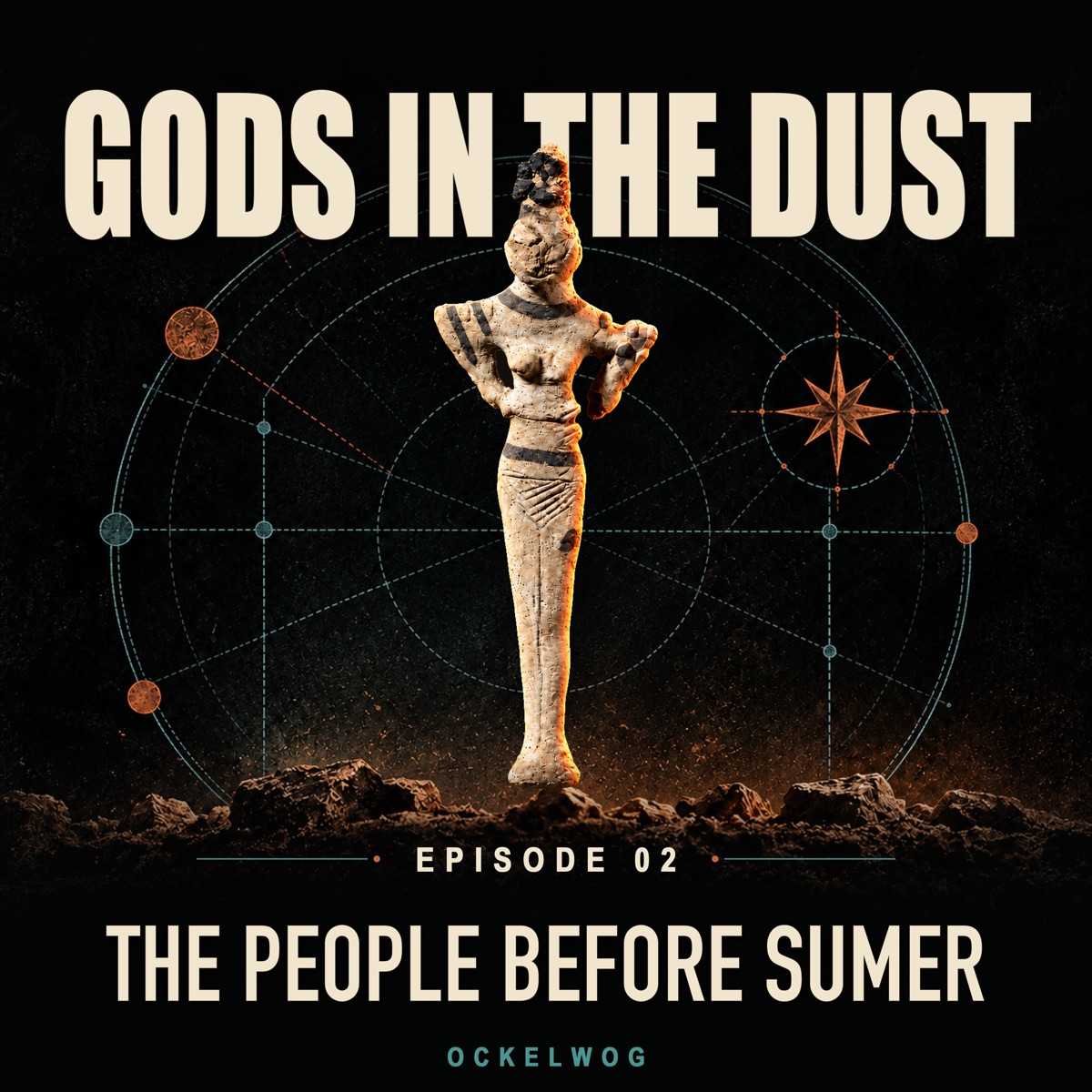
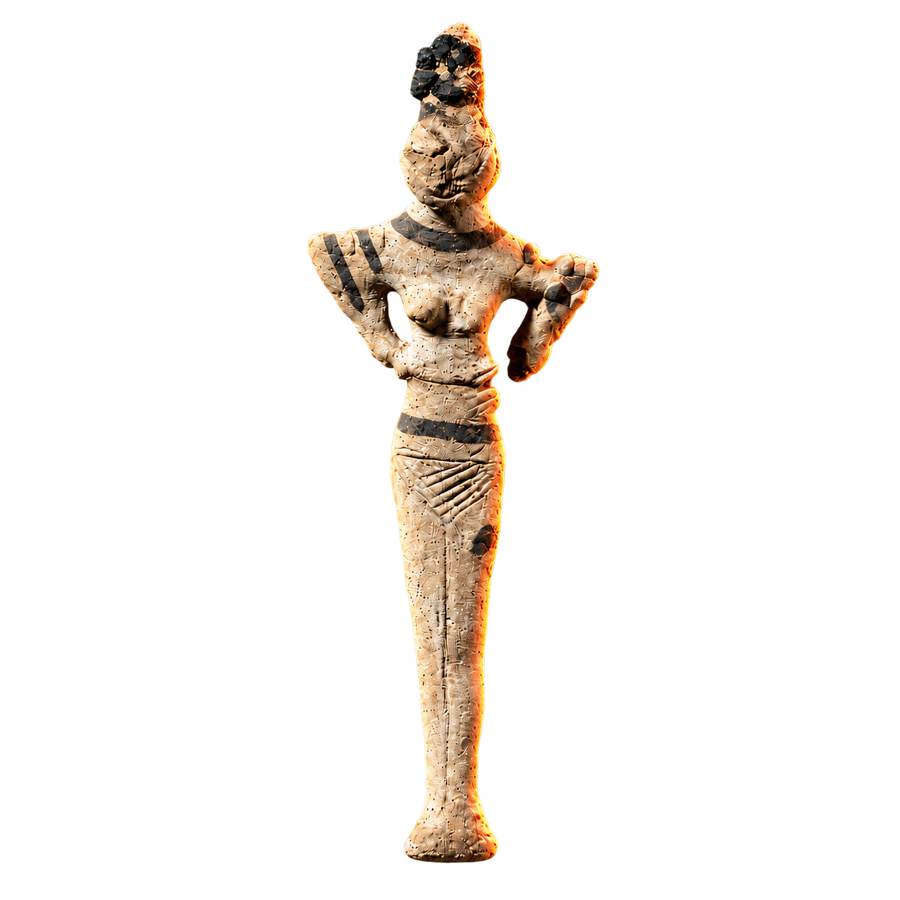
Ockelwog reconstruction. Built from one photograph of a figure from the Ubaid corpus. It represents the type; it is not BM 116894, the figure that opens the episode, and it is not a research scan.
The evidence
Ubaid Figurine
A fired-clay figure made before writing, with an elongated head, deeply incised slanting eyes and a body whose meaning nobody can read from the clay alone.
- Date
- c. 4500 BCE
- Place
- Southern Iraq
Show notes
The objects are authentic. The explanation is not simple. Across prehistoric southern Mesopotamia, people made slender clay figures with long heads, deeply cut eyes, painted bodies, and faces later archaeologists called “ophidian.” A few accompanied selected adults into graves. Two hold infants with the same strange features. Mariana and Tyson trace the most famous example from Tell al-Ubaid into the British Museum, then test the claim that the figures portray a reptilian or hybrid population that preceded Sumer. The investigation moves through household debris, selective burials, red mineral pigment, older artistic traditions, and human remains that may preserve intentional cranial shaping. The non-human theory fails its archaeological predictions, but the conventional labels fail to explain the figures completely. What survives is a more intimate mystery: people before writing used bodies and clay to mark identities we can still see but can no longer read.
Sources
TranscriptRead along. Section times jump the player.
Cold open
Mariana In a glass case at the British Museum, there's a woman's head smaller than the end of your thumb.
Tyson Her skull rises backward into a long point. Her eyes are narrow diagonal cuts, deep enough that something may once have been set inside them. Her mouth is a black line. There's black paint around her throat and over the structure behind her head.
Mariana The museum's own description uses four words that have followed this object everywhere.
Tyson “Female with elongated reptilian head.”
Mariana She was made in southern Mesopotamia before the first known Sumerian writing, before the first named king, and before anyone living there left us a sentence explaining who they were.
Tyson And she isn't alone. Other figures have the same long head, the same cut eyes, the same narrow body. Men and women. At least two women hold infants that have the same strange face.
Mariana On the internet, they've become the Ubaid lizard people. Evidence of a reptilian population before Sumer. A hybrid bloodline. Visitors who arrived before civilization and maybe even started it.
Tyson Which would be easier to dismiss if the objects were fake.
Mariana They're not fake.
Tyson Or if “reptilian” were only a name invented online.
Mariana It wasn't.
Tyson Or if archaeologists knew what the figures actually represented.
Mariana They don't.
Mariana I'm Mariana Eaker.
Tyson I'm Tyson Lukowski.
Mariana And this is Gods in the Dust.
Theme music
A face without a name
Mariana The head in London is museum number 116894. Fired clay. Four-point-two centimeters tall. Less than two inches. It was excavated at Tell al-Ubaid by the expedition associated with Henry Hall and Leonard Woolley, then allotted to the British Museum through the Department of Antiquities of Iraq.
Tyson Which is an unusually tidy biography for an object from a period with no biographies.
Mariana Exactly. We know how it entered a modern collection more clearly than we know why someone made it.
Tyson The date on the museum record is broad. Fifty-nine hundred to four thousand BCE. That doesn't mean this exact head is seven thousand nine hundred years old. It means it belongs to an archaeological tradition that lasted a very long time and is still being refined.
Mariana “Ubaid” began as a label for material found at a site. Archaeologists recognized a distinctive painted pottery tradition and used the modern place name to organize it. The label expanded from pottery, to a period, to a broad interaction zone, and sometimes, too casually, to a people.
Tyson So there was no Ubaid passport.
Mariana No one in the fifth millennium BCE looked across a marsh and said, there goes an Ubaidian. At least no surviving evidence tells us they did. The term is ours.
Tyson But the shared material is real. Related ceramic styles spread across a region more than two thousand kilometers wide, from the Mediterranean side of the Near East toward the Strait of Hormuz.
Mariana With strong local differences. Similar pottery doesn't automatically prove the same ethnicity, language, government, or biological population. Pots travel. Techniques travel. People imitate useful or prestigious forms. Households marry across communities. Networks can produce resemblance without an empire ordering everyone to make the same bowl.
Tyson Southern Mesopotamia is still the center of this particular case. Ur. Eridu. Tell al-Ubaid. Uruk. Tell el-Oueili. Places that later become inseparable from the story of cities.
Mariana Except when these figures were being made, the famous cities hadn't yet become what we know them as. Writing hadn't arrived. The political world of Sumer was still in the future.
Tyson This is the part I find hard to hold in my head. We use a later civilization to orient ourselves toward an earlier one. Pre-Sumerian. Before writing. Before kings. Every description defines these people by what came after them.
Mariana Because what came after them could write its own name.
Tyson And the people who made this face couldn't tell us what to call it.
Mariana Or they could, and the medium they used didn't survive.
How a figurine becomes a witness
Tyson Search for the figure now and the photograph rarely appears alone. It joins a lineup. Long-headed women. A narrow male figure. A mother nursing a child. The images are usually labeled “seven-thousand-year-old reptilians.”
Mariana Sometimes “Sumerian reptilians,” although the point of the claim is that they predate Sumer.
Tyson And then comes the larger story. Non-human beings lived in southern Iraq. They may have been the original gods. They may have taught agriculture, irrigation, architecture, or astronomy. Later Mesopotamian traditions remembered teachers who came from outside ordinary humanity, and these figures show us what those teachers looked like.
Mariana That last step borrows evidence from Episode 1. The apkallu sages. Oannes. The idea that civilization was received.
Tyson Which is why this is worth taking seriously as an argument. Not because every connection works, but because the pieces seem to recognize each other. Ancient Mesopotamia has culture-bringers. It has gods represented with non-human attributes. It has a tradition of kingship descending from heaven. Then, underneath the later cities, archaeologists find bodies with narrow faces and long skulls.
Mariana Clay bodies.
Tyson Clay bodies. But they're not one accidental lump someone squinted at. The features repeat.
Mariana Good. Let's make the strongest version. The figures are deliberately non-naturalistic. The long heads, cut eyes, pointed noses, narrow torsos, and applied pellets occur often enough to form a recognizable type. Both male and female examples exist. Two known women nurse children, and the children's heads participate in the same style. Some figures entered graves. They mattered.
Tyson And we can't open a caption written by the maker that says ceremonial hairstyle, ancestor, goddess, midwife, reptile, or person from the village two canals over.
Mariana Correct.
Tyson So saying “definitely human” can become as lazy as saying “definitely reptilian.”
Mariana If “human” means we know the identity being represented, yes. We don't. If “human” means the makers themselves were Homo sapiens, the archaeological evidence isn't balanced fifty-fifty.
Tyson We'll get there.
Mariana First, we need to notice a trick performed by the photograph. Online, the figure becomes a witness. Its face is treated like a portrait taken under oath. Look at me, it seems to say. This is what we looked like.
Tyson But a figurine isn't a photograph.
Mariana And realism isn't a neutral setting ancient artists forgot to turn on. A human maker chooses which features to enlarge, flatten, omit, paint, pierce, or repeat. The meaning can sit precisely in the distortion.
Tyson A crown makes a head taller because height is the information. An eye becomes enormous because sight is the information. A mask looks non-human because becoming someone else is the information.
Mariana Or a maker repeats a form because that's how a meaningful figure is made. Style can become convincing enough that later viewers mistake convention for anatomy.
Tyson Still, “style” isn't an explanation. It's another question.
Mariana Agreed. So let's stop looking at one face and count the bodies.
One hundred and twenty-one bodies
Mariana Archaeologist Aurelie Daems assembled 121 published, realistically modeled southern Ubaid figurines for a major reassessment. About seventy-nine percent were female, four percent male, and seventeen percent couldn't be sexed, often because the relevant applied or incised clay was damaged or missing.
Tyson Which already corrects the popular montage. Male examples are real, but this is overwhelmingly a female corpus.
Mariana Among the more stylized tubular figures, the distribution changes. Most aren't marked clearly as male or female.
Tyson The realistic figures are generally about fifteen centimeters tall when complete. They were built around a central stalk of clay, then features were applied, pinched, carved, and painted.
Mariana The bodies are unusually consistent. Slender. Flat chests and stomachs. Narrow waists. Long legs divided by one incision. Small feet, sometimes ending in points that can't support the body upright.
Tyson Which may be why some scholars thought the reclining posture enhanced their snake-like quality.
Mariana The heads are exaggerated. The eyes are often oval with a deep horizontal or diagonal cut through them, what the literature calls coffee-bean eyes. The noses project. Paint or small clay pellets appear on shoulders and torsos.
Tyson And there's the word. Ophidian.
Mariana Derived from the Greek word for snake. “Snake-like.” It appears in archaeological writing. The internet didn't invent the reptile comparison out of nothing.
Tyson That matters. If we tell listeners only that conspiracy pages called them lizard people, we make the theory seem stupider than its history. Specialists looked at these objects and also reached for the animal category.
Mariana They did. Other early descriptions called them bird-like, grotesque, or primitive. Those words weren't measurements. They were acts of framing.
Tyson Once you call the body ophidian, every pellet becomes a scale. The pointed foot becomes a tail-like support. The slanted eye becomes reptilian. The object starts assembling itself into the category you gave it.
Mariana And once that category enters the museum record and scholarly vocabulary, a modern writer can say archaeologists admit these are reptilian figures.
Tyson So the claim starts with a real scholarly term and still lands somewhere the evidence doesn't.
Mariana Daems challenged the term for exactly this reason. The long head could represent deliberate cranial shaping, a headdress, or hair. The face could include a mask. The marks on the shoulders might be paint, tattooing, scarification, ornament, or something we haven't recovered. Calling them scales settles a question the clay itself doesn't settle.
Tyson What about the mothers? Because that's the image that makes the reptilian theory feel less like a costume. A mask can come off. A nursing infant shouldn't be wearing one.
Mariana Two examples from Ur show women with babies. Two out of the known female realistic corpus, about one-point-seven percent in Daems's count. Significant, rare, and repeatedly reproduced.
Tyson The photograph selects its own canon.
Mariana Exactly. The two most provocative objects become the type. More than a hundred less shareable fragments disappear behind them.
Tyson But the infant still matters.
Mariana It does. It might make an interpretation based only on adult ritual masks less satisfying. It could support a shared identity expressed from birth. It could also reflect a sculptural convention applied to every human in the scene. What it can't do alone is tell us which answer is correct.
Tyson So morphology gets us to intention. These people meant the figures to look this way.
Mariana Yes.
Tyson But intention isn't identity.
Mariana That's the line.
The graves change the picture
Mariana An object without context is an invitation to fantasy. So where were these found?
Tyson Inconvenient answer: many places, under very different conditions, with a great deal of context lost.
Mariana At Uruk, fragments of older Ubaid objects were mixed into the mudbricks of a later monumental structure. The builders had quarried earlier occupation debris for construction material. A figurine fragment inside that brick doesn't tell us where the original owner kept it.
Tyson At Tell el-Oueili, several early pieces came from settlement debris. At Ur, two early examples appeared in a house alongside pottery, grinders, pounders, flint hoes, clay sickles, net sinkers, and spindle whorls.
Mariana Not a hidden temple. Daily equipment.
Tyson Although ritual objects can live in houses.
Mariana Of course. “Domestic” describes the context, not the belief.
Tyson Then, in later Ubaid levels, some figures enter graves.
Mariana Excavators found forty-nine Ubaid 4 graves at Ur. Six contained one figurine. One exceptional grave contained two. All the grave figurines were female. Two were the nursing women.
Tyson Adults received them. Children and small infants didn't.
Mariana That's one reason the simple toy explanation fails. If these had been beloved dolls, we might expect at least some to accompany children. They don't.
Tyson They also don't look like portraits of the dead. Their bodies and faces are too standardized, and the nursing figures don't appear only with buried mothers and infants.
Mariana The graves with figurines weren't obviously richer in every other respect. Pottery accompanied people across age and sex categories. The special distinction is selective, but its rule is hidden from us.
Tyson There's another link. Red hematite powder.
Mariana In one grave, reddish powder covered the upper body of a person buried without a figurine. The same material colored the face of a figure in another grave. In a third, red covered part of the body while a lump of hematite lay near one of the figures.
Tyson Body and clay body receiving the same treatment.
Mariana Possibly. It's a small sample, but it shifts the question. The marks may be less about reptile skin than about human skin deliberately changed by color, ceremony, or identity.
Tyson And the figurines themselves lie like the dead. On their backs because their feet won't hold them.
Mariana We should be careful. Their inability to stand may have many explanations. But in the graves, formal resemblance between figure and body becomes difficult to ignore.
Tyson Daems suggests these objects may have changed in use over time. Earlier examples circulated in settlements. Later, selected adults were buried with finely made versions. Then the practice disappears. In the terminal Ubaid graves at Ur, no one receives one.
Mariana Which isn't what we'd expect from a population simply sculpting its ordinary anatomy generation after generation. It behaves more like a tradition with a life cycle.
Tyson A tool for a specialist. A marker of rank. An initiation object. An image of an ancestor or being. Something used in a rite we can't reconstruct, then buried so no one else could use it.
Mariana Those are possibilities, not findings.
Tyson But now the real mystery is much more specific. Not “were there lizard people?” It's “why did a few adults take these clay bodies into death?”
Mariana And why did the community stop.
The skulls under the faces
Tyson There's one piece of evidence we've delayed because it changes the temperature of this case.
Mariana The human remains.
Tyson People in parts of the prehistoric Near East intentionally changed the shape of their children's heads.
Mariana This isn't speculation about the figurines. Artificial cranial modification is visible in skeletal remains from multiple places and periods. Pressure applied during infancy can guide a growing skull into a form a community considers beautiful, proper, sacred, elite, or simply recognizable.
Tyson A child can't choose it. Adults begin the process early, while the skull is responsive.
Mariana Which makes head shaping a powerful social mark. Permanent, visible, and assigned by other people. It can communicate group membership or status before the person is old enough to earn either.
Tyson At Eridu, more than two hundred people were recovered from a late Ubaid cemetery. The early physical anthropologist who examined a small selection thought earth pressure after burial might explain their distorted appearance.
Mariana Later researchers have argued there are reasons to take intentional circumferential shaping seriously. At other Ubaid or Ubaid-related sites, modified skulls are clearer. At Tell Arpachiyah, evidence suggests both male and female individuals were shaped, though not everyone was.
Tyson Important qualification. The Eridu material needs detailed reanalysis. We can't place one skull beside one figurine and declare a match.
Mariana But we also can't pretend elongated heads existed only in clay. Some living people in the broader Ubaid world carried deliberately altered silhouettes.
Tyson That's the moment I stopped liking the easy answer.
Mariana Which easy answer?
Tyson “They're just stylized humans.” Just is doing too much work. If the figures remember real head shaping, then the distortion may record a social fact. Someone decided an infant's future identity should be written into bone.
Mariana That's more consequential than a fantasy species.
Tyson And more intimate. A reptilian ancestor can stay in the sky. This happened in a household, over time, through repeated care or restraint.
Mariana We don't know whether every long clay head depicts a modified human skull. Hair, headgear, crowns, and masks remain possible. Different figures may compress more than one sign.
Tyson But head shaping gives us a testable human pathway from body to image.
Mariana Yes. It explains why the feature could repeat in men, women, and infants without requiring a separate species. It also fits the figurines' possible connection to group identity and life transitions.
Tyson And the coffee-bean eyes?
Mariana A sculptural convention with earlier parallels. Daems points to related features on Samarra-period figurines from central Mesopotamia: elongated heads, applied or painted faces, slit oval eyes, flat torsos, pellets or painted marks. The Ubaid type didn't appear from nowhere.
Tyson Which weakens the claim of a sudden non-human arrival.
Mariana It replaces arrival with development.
Tyson Unless a very patient visitor spent generations improving the same clay style.
Mariana A theory can be protected from every result if you let it change shape after each test. That's how it stops being testable.
Tyson There she is.
Mariana You missed her.
Run the visitor test
Mariana Let's state the non-human population theory in a form that can fail.
Tyson A biologically distinct reptilian or hybrid group lived among, ruled, or preceded the human communities of southern Mesopotamia. The figurines are intentional portraits of that group. Their presence contributed knowledge that later developed into urban civilization.
Mariana What should that theory predict?
Tyson First, bodies. Not necessarily many, but anatomical evidence distinguishable from ordinary human variation or deliberate modification.
Mariana We've Ubaid human burials. The reported remains are human. Some skulls may have been culturally shaped. No excavated non-human anatomy has been established in the relevant contexts.
Tyson Second, a stable visual anatomy. If the figures are portraits, the diagnostic features should cohere as bodies rather than as artistic choices.
Mariana Instead, the type includes realistic and stylized pieces, male, female, and sexless forms, painted and applied features, and connections to older figurine traditions. The pointed feet make some figures physically unable to stand, but no one proposes a population incapable of standing without a wall.
Tyson Third, a discontinuity. An arriving population or outside intervention should leave some break in settlement, diet, tools, buildings, craft, or biological ancestry at the proposed point of contact.
Mariana The broad picture instead shows continuity and exchange. Ubaid traditions develop over centuries and feed into the Uruk period. Architecture, communal buildings, craft, accounting practices, and regional networks become part of the long approach to urbanism. Not one delivery date.
Tyson Fourth, memory. Later texts might preserve a description of reptilian predecessors corresponding closely to the figures.
Mariana Later Mesopotamian texts contain hybrid beings, gods, demons, sages, and monsters. That's not the same as a record identifying these much older figurines. The gap is measured in millennia, and no surviving text says the Ubaid clay women depict the apkallu, the Anunnaki, or a pre-Sumerian species.
Tyson That doesn't prove no visitor ever came.
Mariana Correct. It means this collection doesn't provide positive evidence for one. A claim protected only by what hasn't been found can occupy every blank space in prehistory.
Tyson So the theory fails four predictions.
Mariana As an archaeological explanation of these objects, yes.
Tyson But the conventional answers also fail at the point a listener actually cares about. Goddess?
Mariana Unproven.
Tyson Fertility figure?
Mariana Too automatic, especially for slender bodies and a corpus in which nursing scenes are rare.
Tyson Toy?
Mariana Contradicted by the burial pattern, though some figures outside graves could have had different uses.
Tyson Portrait of the dead?
Mariana The standardization argues against simple individual portraits.
Tyson Ritual specialist?
Mariana Plausible inference. Not demonstrated.
Tyson Mask, cranial shaping, hairstyle, body paint, scarification?
Mariana All plausible components. None closes the case.
Tyson Then we end the test with less spectacle and more uncertainty.
Mariana Better uncertainty. The surviving mystery is attached to evidence now.
Civilization without a mastermind
Tyson The visitor story answers more than the face. It answers the whole problem of civilization. Southern Mesopotamia eventually gives us large cities, monumental temples, administrative records, mathematical systems, long-distance exchange, and kings who claim cosmic authority. How did people get from village life to that?
Mariana Slowly, unevenly, and without knowing they were moving toward our textbook chapter called civilization.
Tyson Unsatisfying trailer. Good history.
Mariana The Ubaid horizon matters because so many later developments have roots there. Communities built substantial central structures. They managed water and food in difficult environments. They made standardized objects, moved goods, and sustained relationships across long distances. Clay tokens may have helped represent commodities before writing. Boat models remind us that waterways connected rather than merely divided settlements.
Tyson And the shared pottery is a kind of signal. Not proof of one people, but evidence that communities separated by enormous distances participated in related choices.
Mariana Which may be more impressive than conquest. Styles and practices spread across the interaction zone without evidence for one Ubaid king imposing them.
Tyson Civilization doesn't arrive as a package. It accumulates as habits.
Mariana How grain is stored. How a room is organized. How a feast creates obligation. How a child's body marks belonging. How a household counts what it owes. How one building becomes the place where more people gather than any family can contain.
Tyson None of those decisions looks like the invention of the city while it's happening.
Mariana And no generation needs access to the final plan. That's the mistake behind many lost-teacher theories. They assume complex systems must begin as completed ideas in one mind.
Tyson But irrigation can expand channel by channel. Administration can develop token by token. A ceremonial building can be rebuilt in the same place until continuity itself becomes authority.
Mariana Later people inherit the result. They don't remember the first experiment, only that this is how a proper community works.
Tyson Then, when someone asks where the system came from, “the gods gave it to us” feels more honest than inventing a single human founder.
Mariana Or more politically useful.
Tyson Usually both with this show.
Mariana Usually both.
The people the label replaced
Mariana There's a deeper conspiracy here, but it wasn't organized by reptilian rulers.
Tyson It begins with a genuine silence.
Mariana The makers left no readable text. Later mudbrick builders destroyed or reused earlier contexts. Early excavations recovered extraordinary objects under methods that didn't preserve every association we'd want now. Human remains were sampled unevenly. Collections were divided among institutions. Then a century of labels accumulated.
Tyson Primitive. Bird-like. Grotesque. Ophidian. Fertility idol. Mother goddess. Lizard person.
Mariana Each label creates a complete object out of incomplete evidence.
Tyson And the most dramatic label wins the image search.
Mariana The people themselves recede. They become “the Ubaid,” a single culture spread across a map, or “pre-Sumerians,” defined as an opening act, or a lost non-human race useful to a modern mystery.
Tyson This is where I want to resist the respectable version too. Archaeology can say interaction sphere, material horizon, mortuary variability, and make the lives sound solved because the vocabulary is careful.
Mariana Care isn't the same as completeness. We don't know their language. We don't know what they called the child whose head may have been shaped. We don't know whether the clay woman was feared, loved, consulted, carried, dressed, displayed, or kept out of sight.
Tyson We don't know whether the adult buried beside her had made her.
Mariana Or inherited her.
Tyson Or wanted her in the grave.
Mariana We don't know.
Tyson There's a temptation to treat that sentence as defeat.
Mariana It's also the boundary between those people and us. They're not raw material for any story we prefer.
Tyson The lizard-person theory sees the face and takes it literally. The easy debunking sees the same face and takes it as meaningless stylization. Both avoid the difficult possibility that it was legible to its makers in a way it's not legible to us.
Mariana A face can be human without being ordinary. A body can be altered without being alien. An image can record identity without providing a name.
Tyson And a civilization can have ancestors without remembering them clearly.
Coda
Mariana Go back to the case in London. The head is four-point-two centimeters tall. Fired clay. Black paint. Deep eyes that may once have held inlay. A woman's face made by people who lived before the first surviving sentences of southern Mesopotamia.
Tyson The museum can tell you where she was excavated, who excavated her, when she entered the collection, and the number assigned to her after she arrived.
Mariana It can't tell you her name.
Tyson It can't tell you whether the long skull is bone, hair, cloth, rank, beauty, grief, initiation, or a being no one living remembers.
Mariana The evidence doesn't lead to a reptilian population. It leads to real human bodies changed in infancy, clay bodies marked with paint, selected adults buried with female figures, and a ritual vocabulary that vanished before writing could preserve it.
Tyson Which means the figure isn't proof that non-humans built civilization.
Mariana She is proof that civilization had a deep past before it learned to write its own origin story.
Tyson Next time, a Babylonian scribe draws the world as a circle, puts Babylon near the center, and marks the regions beyond the ocean where ordinary knowledge ends.
Mariana The tablet is broken. The edge of the world isn't.
Tyson Gods in the Dust is published by Ockelwog. Our principal sources for this episode include the British Museum object record and the University of Chicago volume Beyond the Ubaid. Full citations and the evidence ledger are in the episode notes.
Mariana I'm Mariana Eaker.
Tyson I'm Tyson Lukowski.
Mariana And this was “The People Before Sumer.”